

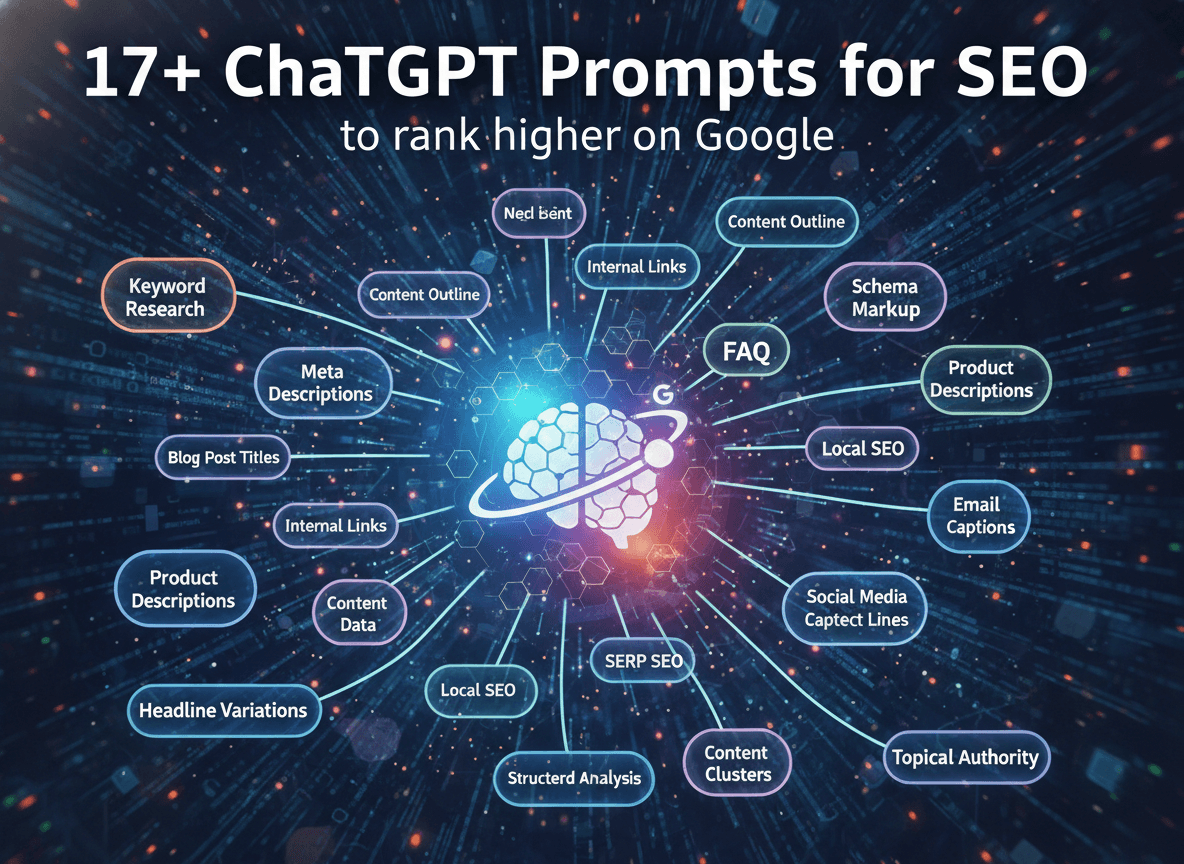
ChatGPT has transformed how many professionals approach daily tasks, and SEO is no exception. If you aim to improve your search engine rankings and increase organic traffic, ChatGPT can be a valuable assistant. This guide shares over 17 specific ChatGPT prompts designed to help you with various SEO activities, from keyword research to content creation and technical optimization. Applying these prompts correctly can streamline your workflow and help you achieve better visibility on Google.
ChatGPT helps with SEO by automating repetitive tasks, generating ideas, and providing quick analysis. It allows you to dedicate more time to strategic thinking and implementing what you learn. Whether you are a content creator, a marketer, or an SEO specialist, integrating these prompts into your routine can help you improve your site's performance. You can find more tools and resources to help you optimize your digital strategies at AISuperHub.io.
1. Comprehensive Keyword Research
Understanding what your audience searches for is the foundation of any successful SEO strategy. ChatGPT assists in uncovering a wide range of relevant keywords, including those you might not discover through traditional tools alone. This helps ensure your content aligns with user intent.
Act as a keyword research expert. Generate a list of 20 primary and secondary keywords for an article about [topic: "best sustainable hiking boots"]. Include search volume estimates (hypothetical if unknown), competition levels (low, medium, high), and user intent (informational, commercial, navigational, transactional).
How to use this prompt: After receiving the list, prioritize keywords with moderate to high search volume and low to medium competition. Focus on intent to match your content goals. For informational keywords, create blog posts. For transactional keywords, optimize product pages. Refine these keywords using other tools like Google Keyword Planner to get actual data. This initial list gives you a strong starting point for content planning.
2. Long Tail Keyword Generation
Long tail keywords are specific phrases, often three or more words, that visitors use when they are closer to making a purchase or seeking detailed information. They have lower search volume but often higher conversion rates because they target a very specific need.
Generate 15 long tail keywords related to [main keyword: "vegan meal prep delivery service"]. Focus on phrases that indicate high purchase intent or specific user needs. For each, suggest a potential blog post idea or product page optimization.
How to use this prompt: Target these long tail keywords in specific sections of your content, FAQs, or dedicated blog posts. Their specificity helps you rank for niche queries, attracting highly qualified traffic. For example, "vegan meal prep delivery service for athletes" could be a standalone blog post discussing its benefits for sports nutrition.
3. Semantic Keyword Expansion (LSI Keywords)
Semantic keywords, sometimes called Latent Semantic Indexing (LSI) keywords, are related terms and phrases that Google expects to see in content about a specific topic. Including them helps search engines understand your content more deeply, signaling its comprehensiveness and relevance.
Provide 10 to 15 semantically related keywords and phrases for the topic [topic: "electric car charging stations at home"]. Think about concepts, questions, and related entities someone researching this topic would also be interested in.
How to use this prompt: Naturally integrate these semantic keywords throughout your article. Do not stuff them. Use them as subheadings, within sentences, and in your introduction and conclusion. This enriches your content and improves its topical authority, signaling to Google that your article covers the subject thoroughly.
4. Content Idea Generation
Creating a consistent stream of relevant and engaging content is vital for SEO. ChatGPT can help brainstorm fresh content ideas that resonate with your target audience and address their pain points or interests.
I need 10 unique blog post ideas for a website that sells [product/service: "sustainable home gardening kits"]. Each idea should target a different aspect of home gardening, appeal to beginners, and be SEO friendly.
How to use this prompt: Review the ideas and select those that align with your business goals and current keyword strategy. Develop these ideas into full articles. Remember to check if similar content already ranks well and look for angles to make your content stand out. This prompt also works for video content ideas or social media campaigns.
5. Blog Post Outline Creation
A well structured outline ensures your blog post is organized, easy to read, and covers all important points. ChatGPT can quickly generate a detailed outline, saving you significant time in the planning phase.
Create a detailed, H2 and H3 structured outline for a blog post titled "The Beginner's Guide to Digital Marketing in 2024". Include an introduction, key sections, actionable advice within subsections, and a conclusion.
How to use this prompt: Use the generated outline as a blueprint for writing your article. Expand on each point, adding examples, statistics, and expert insights. This structured approach ensures you cover the topic comprehensively and logically, which helps with both reader engagement and search engine crawling. A well organized article often ranks better.
6. Meta Title and Description Optimization
Meta titles and descriptions are crucial for click through rates from search engine results pages (SERPs). They tell users and search engines what your page is about. ChatGPT helps create compelling and keyword rich snippets that entice clicks.
Write 5 unique meta titles (under 60 characters) and 5 meta descriptions (under 160 characters) for a product page selling [product: "eco friendly reusable water bottles"]. Each should include the main keyword and a call to action or unique selling proposition.
How to use this prompt: Test different meta titles and descriptions in your content management system. Monitor click through rates in Google Search Console to see which performs best. Remember, while keywords are important, clarity and persuasiveness are key to attracting clicks. Ensure your descriptions accurately reflect your page content to avoid high bounce rates.
7. On Page Content Optimization
Optimizing existing content is just as important as creating new content. ChatGPT can review your text and suggest improvements to boost its SEO value, ensuring it targets relevant keywords and provides value to readers.
Review the following text for on page SEO optimization. Suggest improvements for keyword density (for "affordable web design"), readability, use of headings, and overall content structure. The goal is to rank higher for "affordable web design".

[Paste your article text here]
How to use this prompt: Apply the suggested changes to your article. Focus on integrating keywords naturally, improving sentence flow, and using headings to break up large blocks of text. After making changes, republish the content and monitor its performance in search rankings. Regular content audits and optimization are key to sustained SEO success.
8. FAQ Section Generation
Adding a Frequently Asked Questions (FAQ) section can improve user experience and provide opportunities to rank for question based queries, often appearing in rich snippets. ChatGPT can generate relevant questions and answers based on your content.
Generate 10 common questions and concise answers for an FAQ section related to [topic: "cloud based accounting software for small businesses"]. Focus on user concerns, benefits, and common misconceptions.
How to use this prompt: Incorporate these FAQs at the end of your relevant blog posts or product pages. This directly addresses user queries, increases time on page, and helps Google understand the depth of your content. You can also format these as Schema Markup to potentially gain rich snippets in search results. AISuperHub.io provides resources for understanding and implementing such advanced SEO techniques.
9. Internal Linking Strategy
Internal links are vital for distributing link equity throughout your site, improving navigation, and helping search engines discover new content. ChatGPT can help identify opportunities for connecting related articles.
I have a new blog post about "Benefits of a Mediterranean Diet". Suggest 10 internal linking opportunities from existing articles on my website that cover topics like "healthy recipes", "weight loss tips", "heart health", and "meal planning". Provide the anchor text and the suggested destination for the new article.
How to use this prompt: Implement these internal links within your existing content. Ensure the anchor text is descriptive and relevant to the linked page's content. A strong internal linking structure helps guide users and search engines through your site, improving overall site authority and individual page rankings. Regularly review and update your internal links.
10. Schema Markup Generation (Basic)
Schema Markup helps search engines understand the context of your content, leading to richer search results (rich snippets). While complex schema often requires specialized tools, ChatGPT can help generate basic schema for common elements like articles or FAQs.
Generate basic Schema Markup (JSON LD format) for an "Article" about [topic: "Guide to Buying Your First Home"]. Include author, date published, publisher, and image properties.
How to use this prompt: Copy the generated JSON LD code and paste it into the <head> section of your HTML page or use a plugin if you are on a content management system like WordPress. Validate your schema using Google's Rich Results Test tool to ensure it is correctly implemented and eligible for rich snippets. This can significantly enhance your visibility in SERPs.
11. Content Rephrasing and Improvement
Sometimes your existing content needs a refresh to improve readability, tone, or to incorporate new keywords. ChatGPT can rephrase sections of text, making them more engaging and SEO friendly without changing the core message.
Rephrase the following paragraph to be more concise, use active voice, and target the keyword "sustainable fashion trends".

[Paste your paragraph here]
How to use this prompt: Use this to refine sentences, paragraphs, or entire sections of your content. It is particularly useful for reducing fluff, improving clarity, and naturally integrating target keywords. Always review the output to ensure it maintains your brand voice and accuracy. Regularly updating and improving old content can give it a new life in search rankings.
12. Competitor Content Analysis
Understanding what your competitors are doing helps you identify gaps and opportunities in your own strategy. ChatGPT can analyze competitor content and extract key elements that contribute to its ranking success.
Analyze the content on [competitor URL: example.com/competitor article] focusing on its structure, main topics covered, estimated keyword density for its primary keyword, and any unique selling propositions. Suggest how I can create a more comprehensive and higher ranking article on the same topic.
How to use this prompt: Provide a competitor's article URL. While ChatGPT cannot directly browse live web pages without specific plugins, you can paste the competitor's content for analysis. Use its insights to create content that is more in depth, offers a unique perspective, or fills information gaps not addressed by competitors. This strategic analysis helps you outrank others.
13. Backlink Opportunity Identification
Backlinks from authoritative websites are a major ranking factor. ChatGPT can help you brainstorm types of websites or content relevant to your niche that might be willing to link to your content.
Suggest 10 types of websites or online platforms that would be relevant sources for backlinks to an article about [topic: "benefits of remote work for small businesses"]. Think about industry blogs, news sites, educational resources, and professional organizations.
How to use this prompt: Use these suggestions to conduct outreach. Look for blogs that accept guest posts, industry directories, or news outlets that cite original research. Create compelling content on your site that these platforms would naturally want to link to. Remember, quality over quantity is key when building backlinks.
14. Guest Post Outreach Email Drafts
Guest posting is an effective way to acquire backlinks and build brand authority. ChatGPT can help you draft personalized outreach emails, increasing your chances of getting your pitches accepted.
Draft a personalized guest post outreach email to a blog called [Blog Name: "Marketing Insights Hub"]. My topic idea is "10 Data Driven Strategies for Boosting E-commerce Conversions". Include a brief introduction, explain the value proposition, and suggest a clear call to action.
How to use this prompt: Customize the draft with the specific blog's name, editor's name, and your unique topic. Personalization significantly improves response rates. Highlight how your content benefits their audience. Follow up politely if you do not hear back within a reasonable timeframe. Building relationships with other publishers is a long term SEO strategy.
15. Local SEO Business Description
For businesses with a physical location, Local SEO is critical. Optimizing your Google My Business profile and local directories with a compelling, keyword rich description helps you appear in local searches.
Write 3 variations of a business description (under 750 characters) for a local bakery in [City: "Austin, Texas"] specializing in [Specialty: "gluten free artisan breads and pastries"]. Include relevant local keywords and highlight unique selling points.
How to use this prompt: Use these descriptions on your Google My Business profile, Yelp, local directories, and your website's contact page. Ensure consistency across all platforms. Local keywords like "Austin bakery" or "gluten free pastries Austin" are important. Encouraging customer reviews also boosts local SEO.
16. YouTube Video Title and Description
YouTube is the second largest search engine, and optimizing your video content is crucial for visibility. ChatGPT can help create engaging titles and descriptions that improve your video's search ranking on the platform.
Generate 5 optimized YouTube video titles (under 60 characters) and 3 video descriptions (under 5000 characters) for a video tutorial on [topic: "how to create a simple website with WordPress"]. Include relevant keywords, hashtags, and a call to action in the description.
How to use this prompt: Select the best title and description for your video. Place important keywords at the beginning of your title and description. Include a mix of broad and specific hashtags. In your description, provide a summary of the video, timestamps, links to relevant resources on your website (like https://aisuperhub.io/ for related tools), and a call to action for viewers to subscribe or visit your site.
17. SEO Glossary or Explanations
Sometimes you need to quickly understand or explain complex SEO terms. ChatGPT can provide clear, concise definitions, which is useful for educational content or for clarifying concepts for your team.
Explain the following SEO terms in simple language, suitable for a beginner: "canonical tag", "robots.txt", "crawl budget", "SERP features", "page experience".
How to use this prompt: Use these explanations to create educational content, an SEO glossary on your website, or to inform internal discussions. Simplifying complex topics makes your content more accessible and helps you establish authority in your niche. Clear communication is a key aspect of effective content strategy.
18. Identifying Content Gaps
Discovering content gaps in your niche allows you to create new, valuable content that your competitors might be missing. ChatGPT can help you spot these opportunities by analyzing a broad topic.
Based on the general topic of "sustainable travel", identify 5 significant content gaps that typical travel blogs or guides might not cover extensively. Suggest a unique angle for an article to fill each gap.
How to use this prompt: Review the suggested content gaps and evaluate their potential based on keyword research and audience interest. Developing content around these gaps can position you as an expert and attract traffic seeking specific, often underserved information. This strategy helps differentiate your content in a crowded market.
19. Content Brief Generation
Before writing an article, a detailed content brief guides the writer and ensures the piece meets SEO goals. ChatGPT can generate comprehensive briefs, outlining all the necessary elements.
Generate a detailed content brief for a blog post targeting the primary keyword "best project management software for startups". Include target audience, search intent, competing URLs (hypothetical), word count goal, key headings to cover, important keywords to include, and a suggested call to action.
How to use this prompt: Provide this brief to your writers or use it yourself to ensure all SEO and content requirements are met before writing begins. A well structured brief saves time, maintains focus, and improves the likelihood of ranking success. It acts as a roadmap for content creation.
20. Analyzing Search Intent
Understanding user search intent is crucial for creating content that truly answers a query. ChatGPT can help you interpret keyword phrases and determine the underlying intent, allowing you to tailor your content effectively.
Analyze the search intent for the following keywords: "how to bake sourdough bread", "buy organic sourdough starter", "sourdough bread history", "sourdough bread recipe no knead". Categorize each as informational, navigational, commercial investigation, or transactional. Explain your reasoning.
How to use this prompt: Use this analysis to match your content type to the user's intent. For informational intent, create guides or tutorials. For transactional intent, optimize product or service pages. Correctly aligning content with intent improves user satisfaction, reduces bounce rates, and signals relevance to search engines.
21. Creating Pillar Page Content Outlines
Pillar pages are comprehensive guides that cover a broad topic in depth, linking out to more specific cluster content. ChatGPT can help structure these important pages, which are central to a robust content strategy.
Develop a comprehensive pillar page outline for the broad topic "digital marketing strategies". The outline should include major sections and sub sections that cover all core aspects, providing a foundation for linking to more detailed blog posts.
How to use this prompt: This outline serves as the backbone for your pillar page. Each major section can then be expanded into its own cluster content piece, with internal links pointing back and forth. This interlinking strategy builds topical authority and helps search engines understand the relationships between your content, enhancing your site's overall SEO.
22. Website Audit Checklist
While ChatGPT cannot directly audit your website, it can generate a checklist of important SEO areas to review. This helps you systematically identify potential issues or areas for improvement.
Generate a detailed SEO audit checklist for a small business website. Include items related to on page SEO, technical SEO, content quality, and off page SEO.
How to use this prompt: Use this checklist to conduct regular audits of your website. Systematically go through each item, identify any problems, and plan solutions. This proactive approach ensures your website remains optimized and addresses any issues before they negatively impact your search rankings. For assistance with various aspects of SEO and website optimization, you can explore the tools available at AISuperHub.io.
23. Optimizing Product Descriptions for E-commerce
For online stores, product descriptions are not just about selling; they are crucial for SEO. ChatGPT can help you create descriptions that are appealing to customers and rich in keywords.
Write 3 unique product descriptions (each under 200 words) for a [product: "wireless noise canceling headphones"]. Focus on features, benefits, and include keywords like "Bluetooth headphones", "active noise cancellation", and "comfortable fit".
How to use this prompt: Implement these descriptions on your product pages. Ensure they highlight unique selling propositions, address customer pain points, and naturally incorporate relevant keywords. High quality, optimized product descriptions improve visibility in product searches and can significantly impact conversion rates.
24. Crafting Social Media Post Ideas for Content Promotion
Promoting your content on social media helps drive traffic and signals to search engines that your content is valuable. ChatGPT can generate engaging social media post ideas to amplify your reach.
Generate 5 unique social media post ideas (for Twitter, LinkedIn, and Facebook) to promote a new blog post titled "The Complete Guide to Remote Work Productivity". Include engaging questions, relevant hashtags, and a call to action.
How to use this prompt: Adapt these ideas for your various social media platforms, tailoring the tone and format as needed. Consistent promotion ensures your content reaches a wider audience, increasing visibility and potentially earning more backlinks and social shares, which indirectly support your SEO efforts.
25. Generating Local Business Citations List
Local citations are mentions of your business's name, address, and phone number (NAP) on other websites. They are critical for local SEO. ChatGPT can suggest categories of websites where you should seek these citations.
List 10 types of online directories, review sites, and local platforms where a [business type: "Italian restaurant"] in [City: "San Francisco"] should create or update local business citations.
How to use this prompt: Create profiles or update existing ones on these platforms. Ensure your NAP information is consistent across all listings. Inconsistent information can confuse search engines and harm your local ranking. This consistency is a simple but impactful local SEO task.
Final Thoughts on Using ChatGPT for SEO
Integrating ChatGPT into your SEO workflow helps automate many tasks, freeing up your time for more strategic planning. From generating keyword ideas and content outlines to optimizing meta descriptions and crafting outreach emails, these prompts provide a solid framework.
Remember, ChatGPT is a tool; its effectiveness depends on the quality of your prompts and your ability to review and refine its output. Always combine its suggestions with your own expertise and data from analytical tools. Continuously monitor your SEO performance and adjust your strategies based on what works best for your website.
For more AI driven tools and expert prompts to enhance your digital marketing and content creation efforts, visit AISuperHub.io. Staying updated with AI advancements can give you a significant advantage in the competitive world of search engine optimization.


